Blog|Sciatica: What Causes It and How Do You Actually Fix It?
By Dr. Pat Buchar
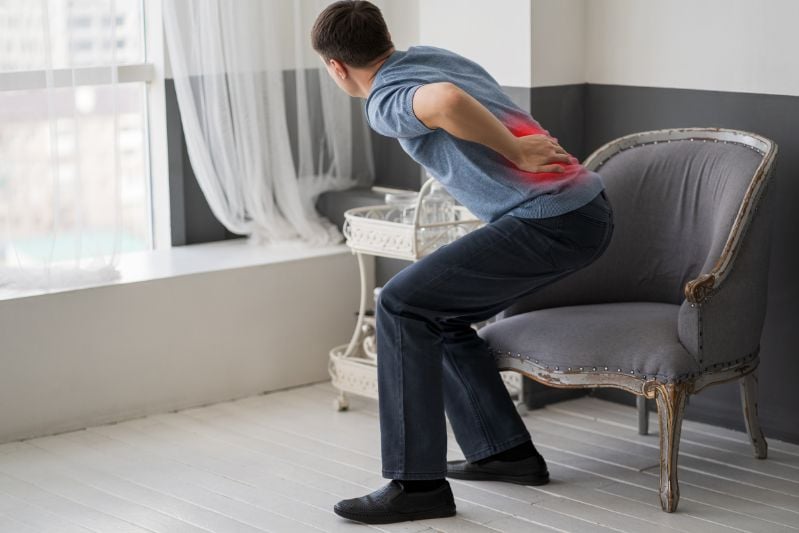
If you’ve ever had pain shoot from your lower back or buttock down your leg, there’s a good chance someone has told you that you have sciatica.
The term gets used pretty loosely. I’ve had patients come in and tell me they have sciatica because their lower back hurts. I’ve had others diagnosed with sciatica because they have pain in the back of the thigh. Sometimes that’s exactly what’s happening. Other times, we’re dealing with something completely different.
Sciatica isn’t really a diagnosis by itself. It describes a pattern of symptoms involving irritation or compression of the nerve roots that contribute to the sciatic nerve.
And if we’re going to treat it effectively, that’s an important distinction.
What Does Sciatica Feel Like?
The sciatic nerve is the largest nerve in the body. It originates from nerve roots in the lower spine and travels through the pelvis and down the leg.
When one of those nerve roots becomes irritated, symptoms can show up anywhere along that pathway.
A person with sciatica may experience:
- Sharp or burning pain through the buttock and leg
- Pain traveling below the knee
- Numbness or tingling in the leg or foot
- A pins and needles sensation
- Weakness in certain muscles of the leg or foot
- Lower back pain along with leg pain
- Symptoms that become worse with sitting, bending, coughing, or sneezing
One of the first questions I ask is exactly where the symptoms travel.
Pain that stops in the lower back is different from pain that travels into the buttock. Pain that reaches the foot along with numbness or weakness tells me something different again.
Those details matter.
What Actually Causes Sciatica?
The most common cause is irritation of a lumbar nerve root, often related to a disc problem.
A herniated disc can extend into the space where a spinal nerve travels and irritate that nerve. The irritation can be mechanical, inflammatory, or a combination of both.
But a herniated disc isn’t the only possible cause.
Sciatic symptoms can also be associated with:
- Degenerative changes in the lumbar spine
- Spinal stenosis
- Foraminal narrowing
- Spondylolisthesis
- Certain injuries
- Less commonly, conditions outside the spine
This is why I don’t like hearing someone say, “It’s just sciatica.”
The next question should always be: What’s causing the sciatica?
That’s what determines what we do about it.
Is Sciatica the Same as a Pinched Nerve?
They’re closely related terms, but they’re not exactly interchangeable.
“Pinched nerve” is a general description people use when a nerve is irritated or compressed. Sciatica specifically refers to symptoms involving the nerve roots that form the sciatic nerve.
You can have a pinched nerve in your neck that causes symptoms into your arm. That isn’t sciatica.
You can also have irritation of a lumbar nerve root that produces pain, numbness, tingling, or weakness down the leg. That’s the pattern we generally associate with sciatica or lumbar radiculopathy.
Is Piriformis Syndrome the Same as Sciatica?
Not necessarily, and this is another area where terminology gets confusing.
The piriformis is a small muscle deep in the buttock near the sciatic nerve. Problems in this region can sometimes produce buttock and leg symptoms that resemble sciatica.
But if the problem is occurring around the piriformis rather than at a lumbar nerve root, we’re dealing with a different mechanism.
There are also problems involving the hip, sacroiliac region, muscles, and other tissues that can refer pain into the buttock or leg.
This is exactly why the location of pain alone isn’t enough to diagnose the problem.
Why Does Sciatica Hurt So Much?
Nerve pain can be miserable.
Muscle pain is often described as aching or soreness. Nerve irritation can feel completely different. Patients may describe burning, electricity, stabbing pain, numbness, tingling, or a sensation that shoots down the leg.
The intensity can also be misleading.
Severe pain doesn’t necessarily mean severe structural damage. At the same time, relatively little pain doesn’t guarantee that everything is fine.
If someone tells me the pain is improving but they’re developing more weakness in the foot, I’m much more concerned about the weakness.
Neurological function matters.
Does a Herniated Disc Mean You Will Have Sciatica Forever?
No. This is one of the biggest fears I see after someone gets an MRI.
They read “disc herniation” and immediately assume their back is permanently damaged.
That’s not what the research shows.
Disc abnormalities are found in people who don’t have pain at all, which is one reason an MRI finding has to be interpreted in the context of the examination. Research has also documented that herniated disc material can decrease in size over time.
The body is capable of healing and adapting.
That doesn’t mean every disc herniation disappears, and it doesn’t mean every case of sciatica resolves quickly. It does mean an MRI report shouldn’t become a life sentence.
Can Sciatica Go Away Without Surgery?
Yes. Many cases are initially managed without surgery when there isn’t significant or progressive neurological loss or another emergency finding.
Current evidence supports conservative management as an appropriate first approach for many lumbar disc herniations in the absence of serious neurological deficits or cauda equina syndrome.
What “conservative treatment” means can vary considerably from person to person.
Depending on the cause, examination, and stage of the problem, care may involve activity modification, specific exercise, rehabilitation, manual therapy, education, and gradually returning to normal activity.
I wouldn’t expect the exact same plan to work for every person with sciatica because every person with sciatica doesn’t have the exact same problem.
Should You Stretch Your Sciatic Nerve?
This is one of the first things people try, and it isn’t always a good idea.
Someone feels pain in the back of the leg, assumes the hamstring is tight, and starts aggressively stretching it.
But a nerve isn’t a hamstring. If the nerve root is already irritated, repeatedly pulling tension through the nerve may aggravate symptoms in some people.
That doesn’t mean stretching is always wrong. It means the exercise has to match the problem. One of the simplest rules I give patients is to pay attention to where the symptoms are going.
If an exercise causes pain that was in your buttock to start traveling farther down your leg, I generally don’t consider that a good response.
If leg symptoms begin retreating and becoming more centralized toward the lower back, that can be a much more encouraging sign in certain mechanical presentations.
Why Is My Sciatica Worse When I Sit?
A lot of patients with disc related symptoms tell me sitting is one of the worst parts of their day. They can walk around fairly well, but a car ride or a few hours behind a desk makes the leg start burning again.
There are several possible reasons for this. Sitting changes the mechanical demands on the lumbar spine, and many people naturally sit with the lower back flexed. Staying in that position for a long period can aggravate certain lumbar conditions.
The answer usually isn’t finding one “perfect” sitting position and never moving. I would rather see someone change positions regularly.
Sit for a while. Stand for a while. Walk when you can. Adjust the workstation. Give your body some variation instead of asking it to tolerate the same position for hours.
Is Walking Good for Sciatica?
For many people, yes. Walking can be a simple way to keep moving without placing excessive demand on the body. Some people with sciatica feel noticeably better when walking.
Others don’t.
Someone with spinal stenosis, for example, may respond very differently to prolonged standing and walking than someone with a disc related problem.
That’s why I hesitate to give universal advice based only on the word “sciatica.”
If walking feels good and doesn’t cause symptoms to progressively travel farther down the leg, it can often be a useful part of staying active.
If every walk produces increasing numbness, weakness, or worsening leg pain, that’s something I want evaluated.
Can Chiropractic Care Help Sciatica?
For some patients, chiropractic care can be part of a conservative treatment plan.
But this is another place where I think we have to be honest about what the evidence actually says.
Recent reviews of nonsurgical treatments have found potential benefits from approaches including spinal manipulation, exercise, neural mobilization, and combined conservative care. At the same time, the overall evidence for chronic sciatica remains uncertain, and there isn’t high quality evidence showing that one nonsurgical treatment is superior for everyone.
That fits with what I see clinically. I don’t treat “sciatica” with one standard adjustment. I treat the person in front of me.
If I believe the symptoms are mechanical and the examination indicates that chiropractic care is appropriate, the plan may involve improving spinal movement, reducing aggravating mechanical stress, addressing movement deficits, and progressively rebuilding strength and function.
Sometimes that includes adjustments. Sometimes exercise becomes the bigger part of the plan. Sometimes the examination tells me the patient needs an MRI or another provider involved.
The diagnosis comes before the treatment.
Do You Need an MRI for Sciatica?
Not necessarily.
An MRI can be extremely useful, particularly when there are significant neurological findings, symptoms aren’t progressing as expected, or the result is likely to change how the condition is managed.
But imaging isn’t automatically necessary just because pain travels down the leg.
When I evaluate someone with suspected sciatica, I want to know:
- Where does the pain travel?
- Is there numbness or tingling?
- Has strength changed?
- Are reflexes normal?
- What movements reproduce the symptoms?
- Does coughing or sneezing aggravate the pain?
- Is the patient improving, staying the same, or getting worse?
Those answers help determine whether advanced imaging is warranted.
When Is Sciatica an Emergency?
Most sciatica isn’t an emergency.
There are, however, neurological symptoms that should not be watched for a few weeks to see what happens.
Seek prompt medical attention for symptoms such as:
- New loss of bowel or bladder control
- Numbness around the groin or saddle area
- Significant or rapidly progressing leg weakness
- Severe symptoms affecting both legs
- Major trauma accompanied by neurological symptoms
These can indicate significant neurological involvement and require immediate evaluation.
Progressive weakness also deserves attention even if the pain itself isn’t terrible.
Again, pain isn’t the only thing we’re measuring.
How I Evaluate Sciatica at Crown City Chiropractic & Wellness
When someone comes into our Charlotte office with leg pain, I don’t assume it’s sciatica before examining them.
I want to know when it started, what they were doing when it started, exactly where the symptoms travel, which positions make it worse, and whether there have been changes in strength or sensation.
From there, the examination may include:
- Lumbar range of motion
- Orthopedic testing
- Neurological testing
- Reflexes
- Muscle strength
- Sensory testing
- Postural assessment
- Hip and pelvic evaluation
- Functional movement testing
- Digital X rays when clinically indicated
If I think advanced imaging is necessary, we’ll discuss it.
If I think the problem needs to be evaluated by another specialist, we’ll discuss that too.
I would much rather tell a patient they’re not an appropriate candidate for what I do than try to force every problem into the same treatment plan.
What Can You Do at Home for Sciatica?
The first thing I tell people is to stop repeatedly doing whatever clearly makes the symptoms worse.
That sounds obvious, but it isn’t always what happens.
People find a stretch online and continue doing it even though the pain travels farther down their leg every time. They spend all day sitting because movement hurts. Or they completely stop exercising because they’re afraid they’ll damage their back.
Usually, the better approach is somewhere in the middle.
Stay reasonably active within what you can tolerate. Change positions frequently. Walk if walking feels good. Avoid repeatedly provoking the nerve. Pay attention to whether symptoms are moving farther down the leg or retreating toward the back.
Most importantly, if the symptoms aren’t improving or you’re developing numbness or weakness, get evaluated instead of trying another random exercise from the internet.
How Long Does Sciatica Take to Heal?
There isn’t one timeline.
The cause matters. The severity matters. How long the symptoms have been present matters. Neurological involvement matters.
Some people improve relatively quickly. Others deal with symptoms for months.
What I care about is the direction you’re moving.
Is the leg pain becoming less intense? Are you able to sit longer? Is numbness decreasing? Is strength returning? Are symptoms traveling less distance down the leg? Are you getting back to normal activity?
Those are useful signs of progress.
Pain being a 4 instead of a 6 is helpful, but it’s only one part of the picture.
The Bottom Line
Sciatica tells us where you’re experiencing symptoms. It doesn’t automatically tell us why they’re happening.
A herniated disc may be responsible. Spinal stenosis may be involved. Degenerative changes may be contributing. Sometimes something that feels like sciatica isn’t actually coming from the sciatic nerve at all.
That’s why the examination matters.
If someone walks into my office and says, “I have sciatica,” my next question isn’t how quickly I can adjust them.
My question is: What’s irritating the nerve?
Once we have a better answer to that question, we can make a much better decision about what to do next.
At Crown City Chiropractic & Wellness in Charlotte, that’s the approach I take with sciatica, lower back pain, and other nerve related complaints. Figure out what we’re dealing with first. Then build the treatment around the person.
Frequently Asked Questions About Sciatica
What is the main cause of sciatica?
A common cause of sciatica is irritation of a lumbar nerve root associated with a herniated disc. Spinal stenosis, degenerative changes, and other conditions can also produce sciatic symptoms.
How do I know if I have sciatica?
Sciatica commonly causes pain, burning, numbness, tingling, or weakness that travels from the lower back or buttock into the leg. A physical and neurological examination can help determine whether the symptoms are actually coming from a lumbar nerve root.
Can sciatica go away on its own?
Yes. Many cases improve over time, particularly when there isn’t significant or progressive neurological loss. The appropriate treatment depends on the cause and severity of the symptoms.
Is it better to rest or walk with sciatica?
Complete bed rest generally isn’t the goal for uncomplicated sciatica. Many people tolerate walking well, although this depends on the underlying cause. Activity should be adjusted based on how symptoms respond.
Can a chiropractor help with sciatica?
Chiropractic care may be appropriate for some people with mechanically related sciatica. The evidence for individual nonsurgical treatments varies, so care should be based on the examination, neurological findings, and underlying cause rather than using the same treatment for everyone.
What makes sciatica worse?
Prolonged sitting, bending, certain lifting movements, coughing, sneezing, or specific exercises may aggravate symptoms depending on the cause. Different types of sciatica can respond differently to movement.
Should I stretch if I have sciatica?
Not every stretch is appropriate for every case. Aggressively stretching an irritated nerve may worsen symptoms in some people. Exercises should be chosen based on the individual’s presentation and response.
Does sciatica mean I have a herniated disc?
No. A herniated disc is a common cause, but spinal stenosis, degenerative changes, and other conditions can also cause sciatic symptoms.
When should I worry about sciatica?
Progressive weakness, bowel or bladder changes, saddle numbness, severe bilateral symptoms, or major neurological changes require prompt medical evaluation.
Does sciatica require surgery?
Most cases do not automatically require surgery. Surgery may become appropriate in certain cases involving significant neurological deficits, cauda equina syndrome, or persistent symptoms where the expected benefits justify an operative approach. Research comparing surgery with nonsurgical care suggests surgery can provide faster relief in selected patients, while differences can become smaller over longer follow up.
About Dr. Pat Buchar
Dr. Pat Buchar, D.C. is the founder of Crown City Chiropractic & Wellness in Midtown Charlotte, North Carolina. Dr. Buchar has more than a decade of experience in chiropractic practice and has performed over 100,000 adjustments. His approach combines chiropractic care with detailed examination, movement and postural assessment, rehabilitation, and patient education to help determine why a problem is occurring and what can be done about it.
Crown City Chiropractic & Wellness
The Metropolitan | Midtown Charlotte, NC
Ready to Start Your Wellness Journey?
Scheduling is easy. Book your first visit online in just a few clicks, or give us a call—we’re happy to help.
Prefer to call?
Monday & Wednesday
7:00 AM – 11:00 AM & 2:00 PM – 6:00 PM
Tuesday & Thursday
2:00 PM – 6:00 PM
Friday
7:00 AM – 11:00 AM

Charlotte's trusted partner for proactive chiropractic care and wellness.
Resources
© 2026 Crown City Chiropractic & Wellness. All rights reserved.
- Privacy Policy
- Terms of Service
- Accessibility